

WORKSHOPS & FACILITATION
There’s a change on your calendar.
Better tools for people changing legal — practical legal design and contract design kits, methods, and facilitation guidance, built around a simple, research-informed process. Run it yourself, or bring us in to facilitate. Turn a messy legal challenge into a structured conversation and a shared next step.
Understand the people and context. Define the right problem. Make ideas tangible. Learn from feedback.
Built on legal design, human-centered design and learning research. Made for the realities of legal work.
↑ FREE RESOURCE
Kickstart your journey to legal design today
You know something needs to change
A legal service isn’t working as well as it could. A contract makes perfect sense to the lawyers who drafted it and to almost no one else. New legal technology gets rolled out before anyone’s actually defined the problem it’s meant to solve. Or you’ve got people with genuinely different views on what needs to happen next, and no shared way to get them there.
It’s tempting to skip straight to solutions. Most people do.
Lawyers Design School gives you a structured way to work through them and the facilitation materials to lead that work yourself.


Our Legal Design Method
A simple process for complex legal change
Thousands of templates and canvases exist online. Almost none of them tell you what to actually do with them: whose perspective matters here, which problem is worth solving, when to get people in a room, how to turn what you’ve learned into something real, what to do with the feedback once you have it.
Everything at Lawyers Design School is built around a process. Not a pile of disconnected exercises borrowed from a dozen different templates.
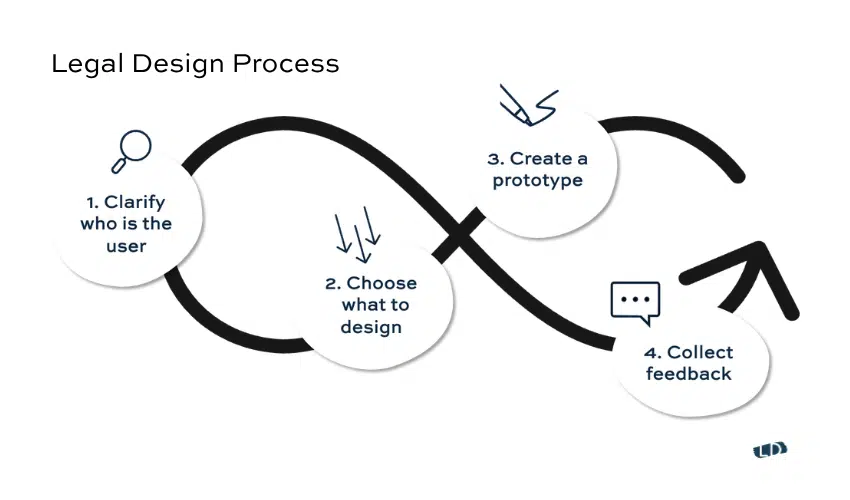
Our Legal Design Process
- Clarify who is the user – start with reality, not assumptions
- Choose what to design – find the problem worth solving
- Create a prototype – make possibilities tangible
- Collect feedback – learn before you finalise.
Then go again. What you learn in step four can send you straight back to step one, and that’s the process working.
Developed by Hannele Korhonen and her team in 2021, the process adapts the Double Diamond framework for the legal context. It’s since been examined in a peer-reviewed research article (Korhonen & Toivonen, 2025) as a framework for how design-based workshops support real organizational learning and change.
Learn legal design
Contract Design School
A self-paced course for redesigning contracts your users actually understand.
Facilitator Course
Learn to run legal design workshops with confidence, step by step.
You bring the challenge. We bring the process
Nobody should have to start from a blank slide deck. Or dig through hundreds of generic facilitation exercises hoping one fits. Or reinvent the workshop process every single time something needs to change.
Our kits are ready-to-use processes and materials that put our Legal Design Method into practice.
Depending on the kit, you’ll find:
Facilitation guidance · workshop agendas and timed sessions · exercises and canvases · editable slides · stakeholder mapping and interview guides · participant materials · preparation guidance · facilitation prompts · next-step tools
Some kits also include AI companions trained on our own methods and materials, for extra guidance while you work.
Adapt the materials to your context. Bring the right people together. Spend your energy on the actual challenge, not on designing the process from scratch.
Prefer to have it facilitated for you? We do that too.
Every kit is yours to adapt and bring into your team’s engagement. This was built for legal work — it’s not generic design-thinking content with “legal” bolted onto the title.

Why Lawyers Design School?
Built from practice. Grounded in research.
Hannele Korhonen founded Lawyers Design School — a lawyer, facilitator, legal innovator, and researcher who’s spent years at the intersection of law, design, and how people actually learn.
Our Legal Design Method didn’t come from a whiteboard session. It came from facilitating legal design processes, teaching lawyers and legal teams, and paying attention to what happened when human-centered design met a genuinely complicated legal problem.
The aim is simple: turn rigorous thinking into practical ways of working.

Featured posts

Better tools for people changing legal
Another folder full of templates won’t help you. Knowing what to do next will.
Start with a structured process. Pick the kit that fits where you are. Adapt it. Learn as you go.
Lawyers Design School – built for the realities of changing legal.