

About Lawyers Design School
Workshop Facilitation for Legal Change
Lawyers Design School helps legal professionals make meaningful change through structured workshop facilitation, grounded in legal design thinking: design thinking adapted for the specific realities of legal work.
We turn design methods into practical processes, tools, and learning experiences made for legal teams so they can understand problems better, involve the people who matter, and create solutions that hold up outside the workshop room.
Having the right answer was never the whole job. Getting there matters just as much.
The story and legal mindset behind Lawyers Design School
It started with a simple question: could legal work better for people?
Lawyers Design School was founded by Hannele Korhonen, a former corporate lawyer, contract specialist, law-firm founder and legal-tech entrepreneur.
Years inside legal services kept surfacing the same problem: legal work could be technically flawless and still leave the person reading it completely lost.
Legal design thinking offered a different starting point. Start with the people using it, not what lawyers wanted to provide. Get curious instead of assuming you already understand the problem. Bring people into the room instead of disappearing behind closed doors to find the perfect answer alone.
That thinking became Lawyers Design School, and, over time, a different legal mindset.
Since then, LDS has brought human-centered design and hands-on workshop facilitation into contracts, legal services, processes, technology, and organizational change, while continuing to ask how design can make law more understandable, accessible, and useful to the people it actually serves.
Hannele’s own path through law, service design, and research shapes the work. So does everything a team at LDS has picked up, workshop after workshop, from the legal teams we’ve worked alongside. None of it happened in a silo.
The question is still the same: how can we make legal work work better for people?
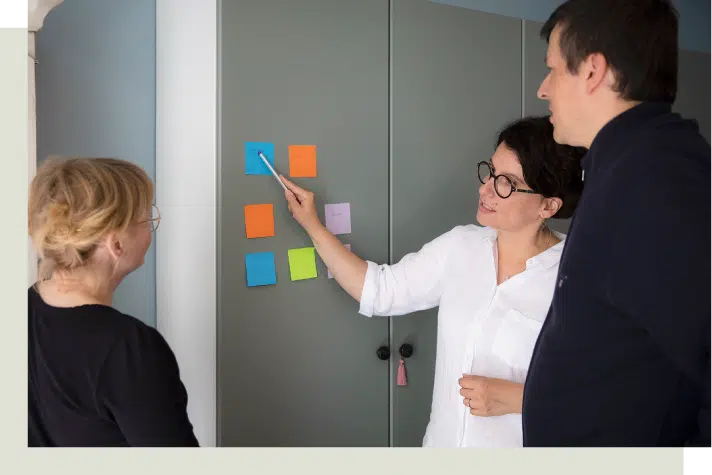
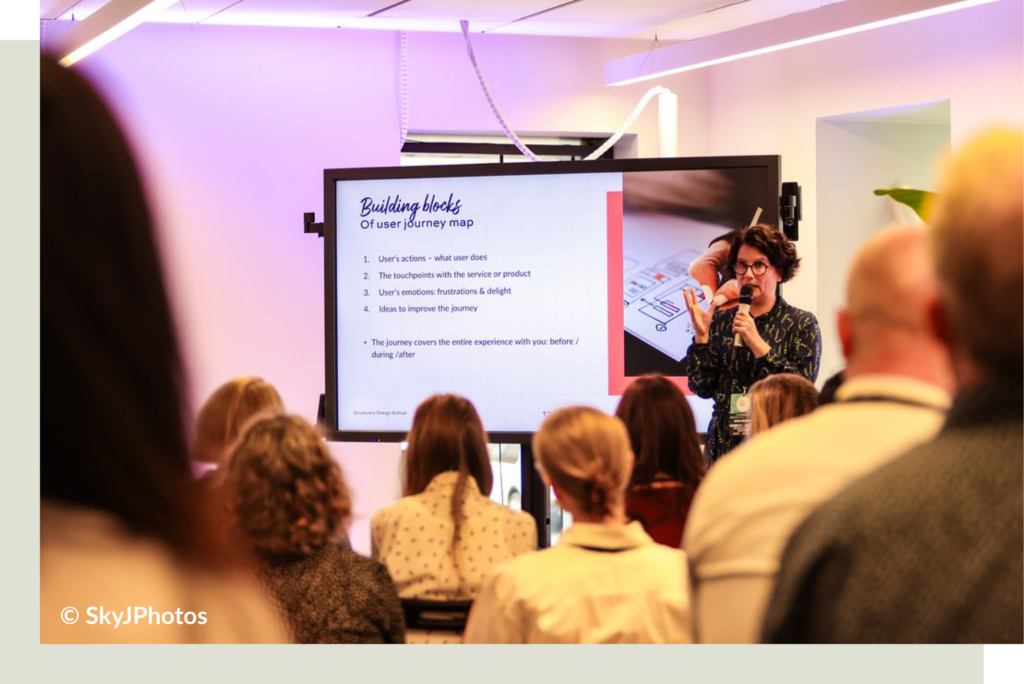
Simple tools. Real facilitation skills. Made for legal.
There are hundreds of design methods and frameworks out there. Legal professionals don’t need to master all of them — or become designers — to work in a more human-centered way.
At Lawyers Design School, we take the thinking behind human-centered design and strip it down to what’s actually usable: simple enough to apply, relevant to legal work, practical enough to put into action today.
That means keeping the thinking behind a tool intact even after you’ve simplified it. Working real legal challenges, not hypothetical ones. Building genuine facilitation skills by doing the work, not reading about it. And facilitating processes that pull in the people who actually live the problem, rather than solving it on their behalf.
The point is not to perform design thinking. It’s to build a team’s own capability to make the next change without us in the room — a clearer contract, a better legal service, an improved process, or just a concrete plan. What sticks longer than any single outcome is the practice: a different way of working through a problem.
Our approach brings together three things
Simplified design tools
We translate human-centered design methods into practical tools that make sense in legal work.
Experiential learning
You don’t learn this way of working from slides alone. You learn by researching, mapping, making, discussing, prototyping, testing, and reflecting.
Designed for the realities of legal work
Methods need to work with real legal challenges, real stakeholders, real constraints, and the expertise already in the room.
Where those three things meet, something important can happen: change. In addition to the better output, a team that’s more confident and capable the next time something needs fixing.
How we think about Legal Design Thinking
Design is more than how something looks.
Design thinking tools can help make a contract clearer or a legal document easier to understand. That’s the easy part.
The bigger opportunity is using design as a way of solving problems — and eventually, as a lens for how legal operations, legal services, and legal departments evolve over time. That means moving:
- From design as form-giving — how can we make this clearer or easier to use?
- To design as process — how can we understand the real problem and create a better solution?
- To design as strategy — how can human-centered thinking shape how we work, make decisions, and create change?
- Towards design as culture — how does the way we work reshape how we think, what we notice, and what we believe is possible to change?
That’s where Lawyers Design School aims. Not decoration. Not innovation theatre. Design as a practical capability for making legal work better.
Why the legal mindset matters
Law shapes people’s lives
Human-centered legal work goes beyond a smoother customer experience. Law and legal systems touch people’s rights, their opportunities, their organizations, their actual days. Accessibility, participation, and understanding have mattered to Lawyers Design School from the start as the reason any of this is worth doing.
Legal innovation has taken us into questions of access to justice, social impact, and more sustainable futures, alongside the more familiar territory of better contracts and services.
The goals shift from project to project. What doesn’t shift: the people affected by legal systems and services deserve a place in how those systems get designed.

Meet Hannele Korhonen
Lawyer. Legal Innovator. Facilitator. Researcher.
I’m Hannele, the founder of Lawyers Design School.
My path here hasn’t been particularly linear, which is probably one reason design feels so natural to me.
I’ve worked as an in-house lawyer and compliance officer, founded a law firm and co-founded a legal technology company. Somewhere along the way I moved deeper into service design, legal design, contract design, and education — and into building the facilitation skills it takes to hold a room of lawyers through a genuinely uncertain process.
I hold a Master of Laws and a Bachelor of Science in Economics, a Diploma in Service Design, and a vocational teaching qualification. I’m also a PhD researcher at the Faculty of Art and Design at the University of Lapland, still chasing the question of how law, design, and change actually intersect.
That inquiry has also produced peer-reviewed research — Korhonen & Toivonen, International Journal of Commerce and Contracting (2025) — examining how the legal design process supports real organizational learning.
In 2024, the work of Lawyers Design School was shortlisted for the Innovation Trailblazer Award at the Legal Innovation Awards, hosted by Legal Week International.
Legal expertise. Design thinking. Facilitation skills built through years of doing this, not studying it. And a stubborn belief that legal professionals build better ways of working when they’re handed the right process and the right person to walk them through it.
Better outcomes. Better future law for all.
Lawyers Design School exists to make human-centered ways of working easier to put into practice in legal.
Whether you’re here for one practical Tool, a complete Kit, hands-on workshop facilitation, or simply a different way to think about a stubborn legal challenge:
Start with the people. Understand the problem. Make something. Learn. Keep going.